Archive for the 'But the Past Isn't Done with Us' Category
Paving the Past
“Well you can fall for chains of silver
and you can fall for chains of gold
you know you fall for pretty strangers
and the promises they hold
well you promised me everything
and then you promised me thick and thin
and now you just turn away and say ‘Romeo?
I think I used to have a scene with him.’”
-Indigo Girls (via Dire Straits), “Romeo and Juliet”
I am almost too depressed to post. I am undergoing this kind of self-enforced torture that comes from thinking through various thoughts which inevitably lead me to something that references some shared part of the past, only for that to jolt me like an electric shock with the idea that this memory, this idea, this concept, whatever it may be, is dead to me. That the past runs thick with poison and the toxicity is threatening to drown everything in my entire memory. I understand the naive desires of those depicted in “Eternal Sunshine of the Spotless Mind”. I comprehend why people voluntarily submit to electro-convulsive therapy, to lobotomy. The process of training one’s mind to set off alarm bells at every fond remembrance is just too painful, too time-consuming, too angsty.
How low can the needle go? I found myself asking this question as an almost rhetorical device for this very process, only to of course realize that such was itself a reference from the past decade, the nine years of my life destined to be obliterated or rigged with criss-crossing booby-trap wires until it’s finally paved over. A snowy drive through the hinterlands of Vermont, New Hampshire, then cross-eyed tired by the time we got to Route 1 between New Brunswick and Princeton. The Kia spinning out under Emily’s wheeled control, the fortuitous placement of the raging semis that dodged us in seemingly every direction before she righted the ship. How thinking through the memory prompts the ultimate and obvious question: what if the worst had happened that day? That day, or a handful like it, so many incidents and accidents along the way that would have cut things short in such a more natural way. It is hard not to yearn for revision, rewriting, re-evaluation, no matter how catastrophic. It is hard not to root for things that could have precluded being here.
We can’t pave the past, of course, neither under the desires of a cataclysmic edit nor the obliteration of surgical removal. We have to live with it, live through it, again and again, eliciting the cold sweats and terror of how quickly a lifetime of memories can be replaced by a graveyard of ghosts. I am haunted, eternally, watching each transformation as golden amber days are rusted into bitterness before my mind’s very eye. When I started this little note, it was about a steamroller or a bulldozer, about new unforgiving asphalt come to pave paradise and put up a parking lot. But nothing is so simple. Instead, it’s the deadly breath of an ice queen, an ice age perhaps, come to blow the life out of all that was good. But instead of bland asphalt, we have only the suddenly broken pieces of what was so recently whole and vibrant.
This is not the way things ought die. They ought decay, wither, descend slowly into the gloom. Cliff-jumping into the abyss is for madness.
The Long Tunnel
New image up top, to reflect what’s going to be a new theme around here for a while. This is the best metaphor, the best way of putting this new chapter of my life that I can imagine. The image is carefully selected: there may be lights along the way that offer the chance at reaching points of new light, but there’s really no telling if it’s a tunnel or a cave. I’m calling it a tunnel because of my incredible faith and pure buoyant optimism. I’m sort of serious. The more that I talk about people and life with other people, the more I realize that what separates me from others is my ultimate idealism. That I spend most of my life sad and disappointed because of how far short things fall from the ideal – most other people have given up on or never believed in that ideal in the first place.
Today Fish dragged me out of the house to run errands with him: bank (my errand), grocery store, cell phone shop, Home Depot. I got sad. Really sad. Sort of unshakably sad. I’m still waiting for the anger. Emily’s waiting for it too. Everyone knows it’s coming, can sort of sense it on the horizon like the palpable evidence of a thunderstorm two hours before the lightning is first visible. But I think I may drown in the sadness before I even get the chance to be mad. I realized anew, wandering grocery store aisles or staring out the window of the Verizon store, how much of my own self-worth and self-perception was wrapped up in being Emily’s husband. How I would prop myself up day-to-day with little thoughts of something nice Em had said or done for me, some little evidence of concern or care. How all I ever wanted was to truly be loved by and love one person, how every one of those 2,568 days was a blessing, even if I didn’t appreciate it enough on every one of those days. How I got used to the best thing that ever happened to me. How I would’ve done things differently if I’d had any idea this was even possible.
I had gotten scared of dying again. I had noticed my vulnerability, my fear of death, my sense of having something to lose. I don’t feel that way anymore. I don’t care what happens to me. I feel a sort of vague intellectual pull that I should care about this, but I just can’t bring myself to really care. The idea of finding another person who I love and trust even half as much, who I can think about marrying or discussing offspring with, it’s just ridiculous. It’s unfathomable. Emily and I were so compatible and so profoundly matched that I just don’t even want to go through the emotional conceptualization of thinking there could be someone else who could compete in my heart. It’s exhausting. Breathing is exhausting. Picking up one foot and putting it in front of the other is exhausting. I just want to sit and stare into space and be listless until my muscles start to atrophy and my body folds in on itself like a limp punctured balloon.
Tonight there will be bowling. Tomorrow a haircut, probably, though the thought fills me with dread and fear even though a certain removal in mourning is necessary. It’s about putting another little headache lamp up in the rafters to maunder aimlessly toward. An artificial light to offer simulative promise of the real light to possibly come some day. There were so many times during these past seven years that I felt unbridled jubilation and euphoria over one thing or another. Some things directly related to Emily, some only tangentially as part of the life we’d constructed together for ourselves. And I would catch myself in my happiness, in my elation, and try to hold it like a lightning bug in a jar. I would know that there would be sorrows and depths unfathomable to come (again, I was more concerned about death than divorce, but still) and I would try to bathe in the warm light of the moment’s satisfaction, to bank it against future withdrawals. I would tell myself that no matter what happened to me, what I lost, I would always be capable of getting back to that moment, to that feeling, to that incredible sense of rightness with the world. I would grab on and say to myself, sometimes literally aloud, don’t ever let yourself lose sight of the capability of this joy.
I am trying, dear past self. Dear naive, unknowing, complacent past self, I am trying so hard to listen to you, to hold on, to find a way to drag myself through the hard unforgiving rat-infested stone tunnel. Oh God, I am trying. It is so hard to care, to want to try, and yet I know, today at least, that I must. Or I should. Or there might be some vague reason to.
Future self, send me a signal. Tell me there’s reason to hope. I’ve spent so much of the last decade trying to send reassurance back to my 1990’s self, telling him I wish he knew that it would be okay. I need it again, all the more so. Life doesn’t get any easier just because it passes. I thought it did and I was wrong. I was just lucky for a while.
I was so lucky.
Just Like Everybody Else
Cuz I used
to be a superhero
no one could touch me
yeah not even myself
and you were like a phonebooth
that I somehow stumbled into
now look at me
I am just like everybody else.
-Ani DiFranco, “Superhero”
There was a long debate when I first got into that song about whether it was about someone losing love or someone who’d been a self-defensive cold-hearted bastard all their life actually admitting they were falling in love for the first time. While I strongly defended my own relatable interpretation of the former, I ultimately had to concede that in the context of all the lyrics, the rest of the album Dilate, and Ani DiFranco’s own prickly self, it was clear that Fish & Co.’s latter interpretation was actually accurate. However, I quote it here in its old familiar (to me) sense. It’s about losing everything.
I recently lost everything. Everything. I’m confronted each day by the enormity of what I have to confront on a public stage (my life, this blog, my future) and how overwhelming it seems to catch everyone up on the events that so quickly precipitated the dissolution of my marriage. It’s vast. It’s embarrassing, more than anything. Losing love is difficult in the best of times, but having one’s wife of seven years who one deeply loves cheat on one with a guy she’d known for eleven days and call one the next day to inform one of her intent to divorce? It’s the most embarrassing thing imaginable. It reduces all existence, all feeling, all possible thought to a sad little rubble of pure pathetic. My life had steeled me for the possibility of trauma, of sudden unexpected deaths of loved ones. But there was nothing, even the horrors of the PLB situation, that prepared me for this. Every day, every month, every year of marriage better girded me against the idea that something like this could ever possibly happen to me. And then it did.
You should know that I don’t have a monopoly on the feelings or perceptions of this situation. Emily has been upset at the way I’m telling this story to people at times. She doesn’t have the right to be and I don’t much care, but it’s worth throwing in a little disclaimer that she thinks a little differently about a couple of the events than I do. The fact is indisputable that the day before she met this other guy, everything in our marriage seemed great to her except for the reality that we were far apart from each other and had been for a long time. The next day, she was diffident and ready to give our marriage the emotional heft and loyalty that one would offer two-day-old Thai leftovers in the fridge. She has backfilled the story of this overnight change with dissatisfactions about compromises and conflicts in our marriage that were typical and predictable in any marriage, that are in fact the basis and nature of any union between two real people in the real world. The day before the other guy, she felt these were just a part of life; the day after, she decided they were irreconcilable. I would feel a lot better about her perspective if she didn’t say things like the fact that she wanted a marriage without compromises, that she thought she’d be more compatible with someone else because they could go biking and swimming with her. From my perspective, she is indulging in a fairy tale brought on by the extreme stress and duress of our long absence and distance and her ensconcement in a very surreal world called Liberia. From her perspective, she thought that what’s happened was inevitable, even though she spent fifty days missing me in the most clearly articulated terms possible.
Emily doesn’t have a blog, at least not one where she’s likely to talk about her feelings. I think things would be better if she did. I think she would be better off if she did. I wish Emily all the best at this point – we are trying hard to forge a friendship and keep things on the bright side of the road. I still love her, and that extends even all the way to the self-sacrificing extent of wishing her happiness without me. But the story must be told at some point, without being gratuitously gory. This blog itself and my whole attitude about open, honest communication is largely the product of a previous situation of deception and heartbreak. I’m not going to react to my wife giving up on me overnight and cheating on me with anything but a redoubling of that effort. And so even though I am now just like everybody else, a divorced 30-year-old man in America with forearm-length trackmarks of my past romantic sufferings, I also have this resilient commitment to the record, to the life lived wide-open, on display, to a heart whose absorbed slings and arrows can be examined, rotated, note-taken, processed. It’s the only thing, along with my friends who read and report, that gives me hope.
People I’ve talked to recently have all commented on how well I seem to be doing with everything. I spent 30 hours on planes going out to Liberia, four extremely challenging days (and especially nights) there, and 16 hours on planes coming back. It’s a lot of time to think, to self-flagellate, to wonder, to contemplate, to cry. It instills self-awareness, perhaps my highest value amidst all this, made all the more profound and vital for both Emily’s apparent lack of same and for my own imperative need to check my own possible overreactions against reality. Everything for a long time to come is going to come back to the idea of being self-aware, of trying to promote a realistic sense in myself that I know what I’m doing, that I’m making decisions for the right reasons and thinking those through. It works pretty well when I’m talking to someone, doing something, not alone with my thoughts. Then it all starts to slide to the abyss whenever I’m alone, whenever I have to deal with things on my own terms. Falling asleep is the hardest. I never had trouble falling asleep before, almost enjoying the little boxing up of the day and the week and the thought processes I was literally putting to bed for the night. Now it’s the end of the world every time.
I’ve moved to Philadelphia temporarily to reduce the alone time. Living in Fish’s spare bedroom, maybe for a few days, maybe a week, maybe more. Emily returns in about a month, knowing when she does whether she’s going to spend the next year in Liberia or back in Princeton. We will give the state of New Jersey word of her intentions then. I won’t be fighting her, but that doesn’t make it my intention. I foresee wrestling for days with applying my name to the dotted line. It’s so dull, so pathetic, so embarrassing, so sad, so American. A seven-year marriage. A divorce. A disposable culture, a disposable world. Disposable feelings. Those leftovers will probably go bad eventually, might as well chuck ‘em now while we still have the chance to buy other food for dinner.
This is not my life. This is my life under the pale descending shadow of a meteor that looms over everyone, lurking in the recesses between your worst nightmares and the last horror film you saw.
People say, when being particularly self-aware, “I could get hit by a bus tomorrow.” Almost always, they say it not as a recognition or an absorption of that reality, but as a way of disregarding trivial thoughts of doom. It’s a prayer for the normal, a supplication for the predictable. They do not say it because they are going to change how they live with that bus in mind. Instead, they say it as a way of showing how many days they have lived without getting hit by that bus, as though this somehow proves the bus is a phantom, is impossible.
You could get hit by a bus tomorrow. I’ve been hit by a few buses in my time already. Watch for flying buses.
Mo(u)rning
He wakes up alone, as he has done for fifty-five consecutive mornings. But it is different this time. The feel of the air, the emptiness, the texture and smell of the environs. He has been here before, repeatedly, and almost always alone. But this is different. Everything is different.
There is no reason to get up. No reason in the world. Dreams are more appealing somehow. This is all but unprecedented, echoes of a wedge-shaped room bedecked with posters and pictures of ineffably distant faces offering mild support and outstretched hands. The soft sad derision of a one-time friend, slinging a shoulder bag in a picture of hurried productivity, shaking his head as he charges out the too-thin rickety door. A roommate. A roommate. The echoes plink down the caverns of memory like a musical pebble. Playing “Moonlight Sonata” or perhaps “Taps”.
Back and forth, left and right, light on both sides, the strange overlarge pillow offering infinite patience as the dreams remain out of reach. They are less scary, less haunting, less true. They will not come back. There is only the dirge-like shuffle of time in its plod, the hard roll of the streetcar, the loungey traverse of the aimless local down the sidewalk. Step, pause, step, pause, step. Living in steps, in hapless direction, in picking up one leaden ankle to put it in front of the other for no particular purpose.
Everybody feels the wind blow. You don’t spit into the wind. The wind has been my friend, my ally, trusted and sure, but it is a force of nature and not to be trifled with. The wind, like time, chooses a direction and points unrelenting, offers assistance in one way but only angst in the other. You can fight it, fight them both, fight everything in your path. But you’re going to lose. You’re going to lose.
I’ve been here before and I deserve a little more.
This is What I Get for Grandiose Titles
Some days are diamonds.
Some days are rocks.
And then there are those special unique days that manage to be both. That manage to be, dare I say it, the best and worst of all possible worlds, rolled into one.
Discretion demands that I don’t speak of this further, but perhaps for this:
The Best of All Possible Worlds is now available in PDF. Drop a line my way if interested.
If you need me, I’ll be trying to surround myself with people.
Summer Chill
It’s amazing how important titles are to my work. I have almost never written a post for this blog without knowing the title in advance of laying down a single word. One of the very few counterexamples was my last post, in which I wrote the title between the last words and the hitting of the slightly pretentious “Publish” button at the bottom of the screen. I didn’t know what the theme was for that post until I finished it. Ironically, the theme was themes themselves, or “threads”.
The theme for this post is “Summer Chill”. There are many possible interpretations of that phrase and I would hazard that all of them are relevant to the intended scope of this post. Read closely, pay attention. You may be surprised what you see. Or you may find the theme trite and blase, which it probably is in some ways, and go off to read about Lady Gaga.
I have discerned that Americans very much don’t like to be hot. This is probably because Americans, as a rule and general practice, are overweight. The precise coordination between weight and heat aversion took me a long time to figure out, but has become in the last few years one of those obvious and universal truths, like “donuts are tasty” or “parents have a lot of both direct and indirect influence on their offspring”. It took me longer to figure out this particular truth because it is generally considered impolite in this society to discuss the weight of other people. Thus conversations like this are unwelcome:
“I’m hot.”
“Really? I think it’s rather pleasant.”
“Well I think it’s too hot.”
“Hm. I guess you are a little pudgy.”
Comments on weight are especially unwelcome from people like me who, despite a two-year period of being somewhat overweight in the middle part of this decade, have otherwise been rail-thin. Since I rekindled my metabolism after its premature death at 27, I’ve gone back to being cold everywhere relative to every other human being, including even those who normally serve the role of being the coldest person they know. Ha ha!
Never is this phenomenon more apparent or frustrating than eating out during the summer in the United States. A phenomenon that I swear was predominantly limited to Florida during my youth has since gone nationwide, and now I must never leave my house without a jacket in summer if there’s even the slightest chance I will be asked to dine somewhere before returning home. In LA, in Albuquerque, in Philadelphia, I relied on my Mariners jacket to save me from hypothermic expiration in the bitterly frigid confines of restaurant after restaurant. After the third one, I stopped asking if I needed to bring my jacket. I would hit the swinging-door threshold, feel the blood harden in my veins, and suit up.
What’s ridiculous about the whole thing is that people keep restaurants at temperatures that no one would enjoy at any other time of year. Two in particular, Waffle House in Albuquerque and Los Segundos in Philadelphia, had the thermostat well below 68 degrees. Imagine going from a crisp November night into a restaurant kept in that meteorological condition. There would be literally no business. No one would go. So why does it being summer make it more acceptable? Why does everyone get to presume that all patrons have just run a marathon in their fat suits before entering their building?
Yes, this is part of an absurd class of things rapidly becoming known as “First World Problems” – the complaints only the spoiled of our species could possibly imagine worrying about, the offshoot of a pampered instant-gratification culture centered on the self. A waste of time, probably, but one that is both alienating to experience and hopefully a bit humorous to relate. And also, perhaps, emblematic of that selfsame pampered spoiled society itself, that we have created expensive, energy-wasting cultural standards and practices designed to cater further to our own self-centered obesity. It’s like the whole thing spirals on itself into the stratosphere to the point where to even observe or complain about our society’s missteps has itself become a misstep that presumes caring about the fate of that society. Paragraph summary: we’re in a fine mess indeed.
I’m reading Don DeLillo’s White Noise and it’s done something that Golding, Tolstoy, Foucault, and Calvino have failed to do in the last month or so: hold my attention. Granted that Tolstoy held my attention about four times as long as DeLillo’s even trying to, so maybe it’s a weak comparison. But he’s also done something else that the other four never approached: scare me. Not because his 1985 vision of the present or the future comes across much like all those movies I’ve seen lately (”Koyaanisqatsi”, “My Dinner with Andre”, “Dial H-i-s-t-o-r-y”, “Double Take”) in its prescient understanding of the incredibly insular self-absorption and chaos to come (it does), but because it reminds me of my own book just finished and nearly fully edited, The Best of All Possible Worlds. Not in whole, not overall (yet), but in certain scenes and themes and focal points. And it not only predates the book by 25 years, but I had never read one word or heard one thing about it before finishing my own tome.
This is at once highly problematic and a little relieving. It’s the former for obvious reasons – on a planet of seven-billion willed agents, I constantly fear accidentally rewriting another person’s book that I’ve never had contact with, just because there are only so many ideas or thoughts out there. As a writer whose greatest asset is originality of ideas, this could lead to unmitigated disaster. At the same time, it’s relieving because the publishing world seems very focused on “comps” – equivalent books to the one being pitched to them that they can in turn use to pitch to potential readers, writing such ridiculous drivel on the back of books as “…with the rich landscape of John Steinbeck, the emotional insight of Sigmund Freud, and the quick-paced action of Dashiell Hammett…” I made that up, but you get the point. No one is allowed to be themselves, at least not at first. Everything has to be derivative. And since I’ve never read anything remotely like The Best of All Possible Worlds, it’s encouraging to run across DeLillo just in time to be able to put a comp in my cover letter.
But also scary. Really, really scary, depending on where it all ends up.
I’m back in Tiny House, by the way, mostly just to block everything else out and finish editing before departing again for roadtrips that will lead up to my series of flights to Africa. The editing is about 70% complete, though there’s the second round of it that comes when I transcribe my red-lined notes into the electronic file that contains the work. It’ll take a while, maybe up to five days. But as an only child, I sometimes just need to be alone, especially to buckle down and do work. Once the work is done, really done, I’ll be sending it out to friends and the one agent who wanted first crack at it, then probably hit the road once more.
So, uh, public service announcement: This is your open call to let me know if you want to read The Best of All Possible Worlds. Your odds are better if you’ve already read and commented on American Dream On, though it would be absurdly self-indulgent of me to require this. Honestly, if you’re my friend and want to see it, that’s enough. Send me an e-mail.
And to leave you on a fun fact for the day, so that we can all laugh about the past and be awed by the present, here’s your news: The girl who said she couldn’t be friends with someone who had a blog had a blog. Far more fascinating than that is what she’s spent the last nine years doing, forsaking some of the first-world concerns she seemed to have in 2001 for time in the Peace Corps in Mauritania and working in Sri Lanka before coming back stateside to work for a really cool organization. I would say I’m proud of her, but that sounds really weird and probably obnoxious since I may have had nothing at all to do with it, especially given the way things ended. So, uh, I don’t have anything to say. Yeah.
I’ve summed up homecomings of all sorts with the following lyrical quotation throughout much of my life. It always has this way of being more transcendentally accurate and true than even all the times I’ve utilized it before. Guess what, “Awareness is Never Enough – It Must Always Be Wonder”? You just got to be the sixth category for this post!
“Looking all around the room
I see the clutter and the gloom
I’m not only back
I’m not only numb”
-Gin Blossoms, “Not Only Numb”
My Life with Soccer
I first discovered the game of soccer when I discovered most of my other contact with sports – in third grade in Oregon. Soccer was the recess game of choice and almost everyone played it. I really loved it for some reason, all of the excitement and passion of the World Cup (which I didn’t know about) seemed relived in every goal and run across the field. I would come home from school and draw up little box scores for the games we’d played, some of which I’m sure I still have somewhere. It wasn’t baseball, which I’d fully embrace later, or basketball, which was particularly handy when it started raining in earnest, but I really liked it for that year of recess.
It was perhaps with this in mind that I decided to try out for the Albuquerque Academy soccer team upon arrival in New Mexico in the fall of 1993. My Mom played a big role in this also, encouraging me to play sports and especially soccer because she’d read that such were a big part of life at the Academy and she envisioned me as athletic because I liked sports. And while I had just gone through a growth spurt that brought me to just about my current full height (5′10″ or so) at age 13, I was about as thin and fragile as possible. I still naively clung to the idea I had a shot at the team up until one of the most farcical exercises I can remember enduring, wherein we paired into partnerships and were asked to lift our counterparts on our shoulders and carry them around the field. It was like asking me to teleport to Saturn. I was appalled, and cut shortly thereafter. Nevertheless, I joined intramural soccer along with most of the other kids cut, certain that it would be better than regular PE. If one of my main 8th grade antagonists hadn’t also joined, it probably would’ve been.
I didn’t really have contact with other people playing soccer until 1994, when I was peripherally aware that there was a “World Cup” going on in the US, but didn’t think it mattered that much. Until, of course, I got to CTY, my second summer going. I’d spent the first summer living with my parents in Baltimore and “commuting” to the JHU campus, but the second summer, in ‘94, I was on my own and boarding in Carlisle, PA at Dickinson College. I flew into Harrisburg, one of the only Westerners going to a place where everyone drove, got picked up by one of the RA’s, and looked around the dorms for everyone I was going to be living with for two weeks. I couldn’t find them.
Suddenly, I heard a great cry go up from a room across the hall. I went to investigate and found twenty or thirty boys laying around in front of a television, rapt. I looked on the screen, awash with the colors of what proved to be the World Cup Final. And so I sat down to watch Brazil and Italy eke out an interminable 0-0 draw and eventually resort to penalty kicks, wherein Brazil triumphed. I wasn’t sure about the whole game, but those penalty kicks sure were exciting. Based largely on this experience, I would spend a long time making fun of world-class soccer as a place where no scoring took place. I remember telling Jake and Kunkel and other friends who liked soccer elaborate stories about epic triumph that ended with the first goal in twelve years of competition finally being scored. They were not amused.
In truth, though, there had been something about that gang of boys huddled around the pomp and pageantry of a game between two utterly foreign countries. Sure, there had been an Italian kid in the mix, a short guy who I went on to overthrow a baseball to and famously shatter a glass emergency exit door. He wound up mostly being a jerk, but maybe it was just because he spent that whole summer with people reminding him that “Baggio choked” on his last penalty kick. But I liked the experience, I liked the game, it was like the Olympics without the American jingoism. Even if the game itself was rather dull.
I had a lot going on in the summer of 1998 and so I sort of casually followed the World Cup in the paper. I remember thinking how crazy it was that France of all countries could win and really coming to understand what an advantage home field was, underscoring what a poor squad the USA really had. I had also discovered at some point that Ireland had a team and that, as my randomly chosen nationality (I’m a European mutt without a culture, so I latched onto Ireland at some point because of my love for the color green and their history of writers and mysticism), this would give me a reason to take special interest in the proceedings. Of course, Ireland failed to qualify for ‘98, so I didn’t pursue my interest too closely.
In 2002, though, Ireland made it and a lot of my friends were following it. This was underscored by the fact that my Mep House roommates, Greg and especially Russ, and I had spent a great deal of the 2001-02 academic school year playing FIFA on the PlayStation hooked up to the TV downstairs. We had randomly adopted Denmark as our team and played on the same squad, trying to navigate the Danes to world-class glory. To this day, I can probably name most everyone on the early 2000’s Danish squad, and “Sand. Sand!” is a universal joke in the Mep language, along with countless other jokes about the wry British and Scottish commentators who make FIFA video games all the more worthwhile.
I wound up watching a lot of World Cup 2002. I stayed with Jake for part of that early summer, and he and everyone in his apartment complex were Cup crazy. I remember the heartbreak of Ireland’s penalty kicks loss to Spain, how well they’d fought for that game. The surprise runs of Korea (homefield again) and Turkey. The inevitability of the Brazilian title again. I went back to Waltham and played a lot more FIFA. I was more or less hooked.
In 2006, I was newly ensconced in my job at Glide, getting the feel for the Tenderloin and my co-workers, many of whom were proclaimed Cup addicts. I was wildly excited for this Cup, even without Ireland in the fold, deciding to root for Sweden, Russia, and anyone playing the United States. I remember the elation of Ghana edging the States and knocking them out in the first round. It was nice to have the games in a time zone where it was not impossible to watch matches live (Korea had been a bit of a challenge). Most of the matches came right in the lunch hour, and I would eat with the other Gliders who were Cup fans in front of a big TV in one of the upstairs offices, or go out to the Thai restaurant that was in a converted bar with the big TV hanging over the bar, always tuned to the current game. It wasn’t watching whole games, which I still found a bit challenging unless I had a clear rooting interest, but it was the perfect slice of action to break up the work day. Sweden, Russia, and Ghana all broke my heart, and we were left to watch the Zenadine Zidane incident in horror and Mep about it later.
Today, I am again saddened by the absence of Ireland, but excited to root for Denmark, for Cote d’Ivoire, which neighbors Em’s locale of Liberia (and has the Irish flag reversed, after all), for Mexico (feeling a slight tug of loyalty there for some reason), for any country playing the United States. Which, today, means England. Now it’s hard for me to root for England, even though I probably have as much English in me as Irish. But them playing the US is enough for me to do it.
It’s interesting, in reflection, to see what a cross-section of my life the World Cup has been. Every four years, I’m somewhere radically different. We could measure out our lives in Cups. I suppose one could do it in any quadrennial event – elections, Olympics, etc. But World Cups seem less arbitrary, more universal. Even than the Olympics.
Anyone’s guess about where I’ll be in 2014 is as good as mine. Probably better.
Farewell, Kid

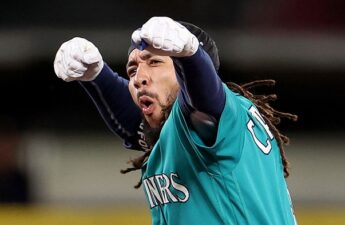
Ken Griffey Jr. reacts to his 616th home run, against the Giants on May 24, 2009. It was the last of his homers I’d see in person.
I moved to Oregon in 1988 and discovered Major League Baseball on a roadtrip down to California that October during the World Series. As I’ve discussed fairly recently, this led to my being an A’s fan for a few years while living in Oregon, though my interest in their green uniforms, elephant mascot, and Mark McGwire was gradually worn down by years of listening to the Mariners Radio Network.
The first year I started listening to baseball was 1989 and the announcers were buzzing about a hot new prospect just called up named Ken Griffey Jr. I think it was Dave Niehaus who first called him The Kid, since his dad was still in the majors (and would be united with him on the M’s the next year). And even though I wasn’t always rooting for them in those first couple years, I listened intently to about a hundred M’s games a year as The Kid lit things up and sparked a previously abysmal Seattle club to something like mediocrity.
The real turning point, of course, was 1995, well after my Mariner fanhood had fully taken hold and I was living in Albuquerque relying largely on newspaper articles and the few rare televised games. I remember being unable to wait to get home from school to see the one-game playoff the M’s had miraculously forced against the Angels after being some incalculable number of games back in late August. The 9-1 drubbing, a thing of beauty. And then the series with the Yankees, the impossible 0-2 deficit, including a heartbreaking 15-inning affair in Game 2. (I still remember Fish telling me at school the next day what a great game it had been and that I must be excited and I got really upset with him. Turns out he’d turned it off after the M’s scored in the 12th. The Yankees then tied it in the 12th and won it in the 15th.) And then, of course, the comeback, capped by the greatest game in Seattle Mariner franchise history, the decisive Game 5 in Seattle. The 5-3 deficit erased in the 8th. Randy Johnson coming in to pitch extra innings. The 6-5 deficit in the 11th. And suddenly, out of nowhere, The Double. Ken Griffey, Jr. steaming around 3rd base, trying to score from 1st. The play at the plate, the epic slide, the dogpile at the plate. And me, at home in New Mexico, jumping up and down like the world was on fire, like I’d just realized that anything in the world was possible.
Then the horror came. A Ken Griffey Jr. poster was one of the first choices I made to fill my vast collegiate wallspace when I got there and while 1998 and 1999 weren’t quite 1995, they were solid seasons. But as 1999 wore on, there were rumblings about Griffey’s desire to retrace his father’s footsteps, get closer to the homestead, be part of the Big Red Machine. I already despised the Reds and this was a nail in the coffin. And by announcing publicly that he wanted to be traded to exactly one team, Griffey destroyed his value and the M’s had to settle for a pitiful return. I was angry, I felt betrayed. Much of the fanbase was more forgiving, but I was resentful. I couldn’t believe he’d done that to us, to the people who’d raised him from 19. How could he leave such a talented team, a crew with A-Rod, Randy Johnson, Edgar? (Yeah, I didn’t know what was coming.) Just for some parental nostalgia? His dad had even retired as a Mariner! Wasn’t that enough?
Well fate was cruel to Grif for the decision and he spent almost a decade in a hellish span of injuries and fan ridicule. He succeeded in tarnishing the Griffey name for almost every Reds fan and made them regret the meager sacrifice they’d made to acquire him. Oh sure, he was still The Kid, still electrifying when healthy enough to put the prettiest swing on a baseball you’ve ever seen. But it was a rare sight and he never quite fit with the red and white. And then he came on an interleague roadtrip to Seattle with the Reds and dropped the bombshell that he’d like to retire a Mariner.
No one could believe he’d just said that. They thought he was joking. But he was less than cryptic in his follow-ups, and before I knew it he’d signed to come to the M’s in 2009. I had the rare treat to see him in three games in May against the Giants and then again briefly as the M’s swung through Baltimore last month. I looked for my old KGJ poster and couldn’t find it, concluding with some horror that I’d probably discarded it in anger when he became a Red. He looked good back in blue, though older, fatter, his body displaying the tired signs of a typical athlete at the very sunset of his career. Most Mariner fans thought he should’ve retired after a decent 2009, and the numbers agree. He failed to hit a single homer in two months this year, finishing below .200 and getting benched with aspersions swirling in the press.
And while the book on The Kid is clearly a storied and memorable one, one of glory and contributing more than any other single individual to keeping baseball in Seattle and putting the Mariners on the map, any description of him is incomplete without measuring him unfavorably against his potential. He could’ve been the greatest. He could’ve hit 800 home runs, all without an ounce of steroids. He could have been The Franchise for all-time.
Of course he probably would’ve been beset by the same injuries in Seattle as he endured in Cincy and all that resentment would have been ours over his decaying body instead of his mild betrayal. But no Mariner fan alive would tell you they haven’t thought, at least once, that he might have stayed perfectly healthy in the cool rainy air of the Northwest. That he would have been not only a legend, which he certainly is, but The Legend. The Michael Jordan of baseball, but with humility.
We’ll never know. But we can thank him and appreciate him for all the things we do know about him. And watch tonight’s M’s game, as I will, knowing that something special is missing and will never return.
The Goal of Humanity
I have long discussed the fact that the goal of humanity, both collectively and individually, is to overcome human nature. That basically everything we consider to be harmful and undesirable is derived from the baser instincts of human beings and that, at the point of sentience, the goal of people should be to stop evolving and to start making mental, philosophical, and moral transformations based on rational thought.
It shouldn’t be a controversial perspective, but it seems remarkably un-universal, especially given the recent surge of belief in science, physicalism, and a reductionist materialist view of the world. So many people now seem to argue that there are great benefits of our human nature and natural instincts, that trying too hard to control or convert the hedonistic nature of our animal selves will create more problems than its solves. Of course, these people tend to put happiness at the keystone position of their ethos and seem particularly ill equipped to explain how humanity is going to make any progress in the fields of moral or rational thought.
I am writing all this now because I recently found one of the most brilliant articles ever on this issue, which makes the case for my perspective more succinctly than I tend to, and in a way more befitting of mainstream appeal. You can read the article here now. Be forewarned, it’s longish, but the details matter and it’s length is sort of part of the point anyway.
The article is more concretely about patience and the ability of people, largely young children, to delay gratification. The case constructed by the psychologists in the various studies profiled in the article is that people’s willpower and ability to distract themselves into changing their own motivations – the essence of self-control – is perhaps a larger factor for success in humans than intelligence itself. And that where intelligence feeds self-control and vice versa, the most essential building blocks to fulfillment and self-actualization are to be found.
I have been telling a lot of people lately that the difference between my ability to write multiple novels in a year (not done yet, but looking awfully promising at this point) or hold down jobs while impressing my employers on the one hand, and being homeless and destitute and an utter failure on the other hand, is entirely because of my ability to fabricate meaning for deadlines in my own head. I mean this statement completely sincerely – the most important skill I have devised in my life has been the ability to believe in an arbitrary date and accord all the significance in the universe to it. Throughout high school and college, I never missed a single deadline for a single class (except for the one I deliberately failed, of course, but that was its own little experiment with self-control), because I convinced myself that doing so would lead to immediate failure, expulsion, and possibly death. I played an extensive eight-year game of chicken with my consciousness, starting papers later and later, studying less and less, but I still turned everything in the minute it was due, without fail.
This has of course translated into me being able to motivate myself for artificial deadlines (imposed by self or others) at work and especially in my new free-form writing life. I thrive on deadlines, at least when they’re realistic. I feel a great deal of adrenaline around the approach of a deadline, the elation of getting things done, and every successfully met deadline has worked as an extra bulwark for both the need for me to continue making them and as a positive motivation from the pure euphoria I feel when they are met.
I don’t think I ever deliberately tried to create this spirit about deadlines, but the article above corroborates my thesis that this trait alone has kept me off the streets and in a relatively stable place in society. But the most important aspect of the article is the evidence that this can be taught. What’s frustrating about the article is that it then starts to raise doubts about the idea of teaching this kind of self-control and willpower, even though most of the article makes it abundantly obvious that this can be learned, and pretty easily, especially at a young age.
The article also relates the issues of self-control and willpower to drug use and overeating, which are pretty obvious correlations. The fact that I’ve been able to live my entire life without alcohol, tobacco, or other drugs, to control any impulse to try them even once, to be able to rationally evaluate the decision and overcome impulse, is highly linked to the deadline thing. And all of these things are truly essential skills for living a fulfilling life, especially if one is also prone to addictions or falling into long sustained periods of inextricable obsession.
The most disturbing aspect of the article, though, is that it still pays homage to the materialist demons that haunt every aspect of the modern psychological community. The researcher who pioneered the study of willpower through the use of marshmallows, whose thinking has led to such important conclusions about humanity’s struggle to overcome its base nature, is most excited at the moment about… brain scans. He wants MRI’s to spit out little illustrations of the self-control fold in the brain so he can give people drugs or surgery to shortcut them to it.
And here is where I have to part ways with the nature of the experiment. It may be that there seems to be a physical reflection of the phenomenon of being able to believe in arbitrary artificial self-imposed deadlines. And it may not. If it is, it’s still putting the cart before the horse, for the fact is that these things can be taught and that would change the folds of the brain. The entire problem with the materialist approach is that it tries to do things backwards, tries to manipulate people as bodies without giving them the understanding of what they need to change that will build a lasting commitment to the new approach. Even if you could surgically create the folds, there’s a larger chance that they’d just change back and re-alter their brain afterwords. This is why so many people who get major life-changing weight-removal surgeries tend to end up putting the pounds back on, while people who actually train themselves to approach food differently can lose weight and keep it off.
So now the goal of humanity is to not only overcome our human nature, but to ditch our desire for a physical solution to every problem. We’ve long recognized that the human mind is the most complex and fascinating aspect of our world. We should offer it the respect and due diligence it deserves, not try to play Frankenstein to its monster.
2010 Summer Tour Announcement: The Best of this Possible World
I am a pretty lucky guy.
It’s nice to get reminders of this, lest I begin to give in to consternation with any given personal quest or quandary at any given time. Though the below-announced “tour” is not a book-signing tour, yet, or anything of that ilk, it is a hearty reflection of how great my friends are, how many of them I am blessed to be able to see, and how fortunate I am to be in a position to contemplate some serious world travel as well.
Coming off a non-weekend weekend spent with the Philly crew, playing endless Wii Mario Kart and real-life tennis (6-4, 4-6, 6-5* over Fish in a reaffirmation that we are just as evenly matched as we were in the ill-fated Spring 1995 intramurals), I cannot express sufficient excitement about the summer ahead. More than anything, my visit just now was marked with exceptional depth and breadth of conversation, the greatest gift we humans can give those we are personally tied to. To have so many old friends with whom I can converse about such an array of topics at a high level makes me even luckier than I know I am.
*We didn’t do the proper tiebreaker thing because both of us forgot how to score it and we were exhausted already.
It is with this incredible fullness of heart that I announce my complete summer plans – possibly the most ambitious and wide-ranging itinerary I’ve ever undertaken. The “theme” is of course related to the thread that runs through these summer plans, work on my third novel (second this year), The Best of All Possible Worlds. The summer kicks off on the actual first day of summer, which happens to be my deadline, and will take me straight through the week of the first debate tournament of next season. I am preparing to be overwhelmed.
Here we go:

If we haven’t made specific contact about spending time on the tour in the above places and times, please send me an e-mail and we can sort things out. Some of this may be subject to a little tweaking, especially the dates that revolve around driving on the Eastern Seaboard rather than booked plane tickets. I may release an edited draft of this with some of those Eastern cities more specified before it’s all upon me.
Now the focus is making sure I can hit that deadline so everything else is viable.
Ghost of Christmas Past
Who would’ve thought that a day in, I’d be almost missing April?
Since writing my last post, I have:
- Had a migraine, making April’s total fourteen.
- Developed some strange but persistent non-migrainous pain and possibly swelling in the soft tissue over my right ear.
- Gone to a “Prom” held for students in Emily’s program.
- Watched the M’s cough up a game where they had the bases loaded with one out in the bottom of back-to-back extra innings.
- Judged the 102nd Harvard/Princeton/Yale Triangular Debate, specifically a Princeton-hosted match against Harvard.
- Written 17 pages of The Best of All Possible Worlds.
- Finally bought a new batch of coffee to test my bad-batch theory for the April Migraine Spike.
- Run – almost literally – into my second girlfriend on the street in Princeton. Yes, that one. No words (or blows) were exchanged.
- Discovered that said girlfriend and her husband have been living less than a mile and a half away since we moved here.
- Watched the film adaptation of Brief Interviews with Hideous Men, which I loved and Em hated.
- Finished reading 2666 by Roberto Bolaño, a novel which is neither about 2666 nor is finished.
I think it can all best be summed up in four words:
My head is spinning.
How Far We’ve Come
I keep a lot of old papers. A LOT. When our moving van rolled over in an accident outside Los Angeles last summer, some people speculated that I didn’t have enough possessions to make this matter that much. The answer is papers. It’s all (mostly) papers.
Indeed, I’ve been known to say that I live much of my life as though I can assume that some archivist will eventually come in and take an interest in my old papers. Granted, that archivist may just be an older me at some point, but I still see a paper discarded as a grave tragedy. I’ve recently been able to do some purges of the really meaningless stuff, such as old receipts and bills, but it’s still pretty hard to get me to cut papers that I’ve taken the time to put pen to.
Often (as with the linked audio clip above), this is the reasonable subject of a small amount of lampoonery. But every now and then, even pre-archivist era, true gems emerge from the boxes and folders that justify the whole project. While searching for Emily’s immunization card last night, she ran across the following:

Click image for larger size (legible!) view.
This document, circa mid-September 2002, was our outline of how to financially survive until October 2002. This crude effort at a budget, made shortly after we’d secured our first apartment, illustrated how close we were to running out of money at the time, especially with the desire to acquire a deftly illustrated “feline friend”. Emily and I remember the ensuing period as the “Month of Ramen”, when we holed up in our house with job listings and hot noodle soup and tried to figure out how we’d spend the next years of our life in the startlingly real world. Despite our concern that we wouldn’t make it till October 2nd jobless, it wasn’t until October 18th that one of us actually secured employment (my part-time job at Chapman).
We never went into debt or had to ask our parents for help. But we sure didn’t know it when we were drafting that document. We had no idea what the future looked like, but it looked potentially bleak. I know it’s no solace to the class of 2010, given how much worse job prospects are in the US now than eight years ago, but it is impressive how well life can turn out despite its scariest early rumblings.
I’m not sure whether I’m more horrified by the idea that we thought $30 could be a monthly cable bill or impressed by the idea that we thought to create this paper in such a forward-thinking light. It seems written for posterity, like some sort of declaration or defining document. Ultimately, I think we were just hoping it wouldn’t be our monetary epitaph.
13 Migraines (or: A Pretty Bad Month)
Used to be that I would get some pretty epic migraines. This was back in high school, before I started drinking coffee regularly, when I was out there in daily life with all the fluorescent lights and loud noise you could shake a stick at. There were migraines that lasted a full week and months when I had more time under the spell of the head-throbbers than free of them.
Then I started drinking coffee regularly, not intended as a migraine medicine (I was experimenting with actual migraine meds, to little avail but much consternation over the risk of stroke) and things quickly got better. Not great, but better. Then I started to make serious moves at trigger controlling after graduating college and things got quite a bit better. The last few years, I’ve been down to something like 30-40 migraines annually.
Enter April 2010. And the hammer dropped. With three days to go, I’ve notched 13 migraines, the longest of which lasted 36 hours (which used to be the norm, but is now sort of an impressive standout). And I probably have to do laundry at some point before the month is up, which has been the most consistent trigger since moving to Jersey (they really love fluorescents in our laundry room… it’s like a sort of shrine to the power of headache lamps).
I noted this April’s phenomenon earlier this month, hinting that maybe I was just on a really bad batch of coffee that was restoring me to the pre-caffeinated 1996 version of myself. While I haven’t tested against a different batch, I’m starting to wonder how to really isolate and test the factors. If there’s something more problematic about April itself, changing the batch of coffee May 1st doesn’t really demonstrate improvement on those grounds if the migraines go away.
What else could be going on in April, you ask? (Especially those of you who, let’s face it, haven’t fully subscribed to my theory that time is place and place is charged with meaning.) Well, there’s a lot of new theories running around about migraines being tied up with barometric pressure. And as I’ve learned since moving back to the region of the world where all our weather-based aphorisms about months hold true (e.g. March comes in like a lion and out like a lamb), there are a lot of storms in April. So that’s a lot of dropping barometers. At the same time, San Francisco is not exactly famous for its stable-to-rising pressure, and I logged some of my least migrainous years while working there daily. So what gives?
As with so much about migraines, I ultimately have to chalk it up to an ongoing mystery, try to test for certain variables (I really do need a new batch of coffee), and take relevant notes. And I must stress in this latter element that the symptoms are completely textbook. I really don’t think these are the early signs of some larger head problem, unless that head problem perfectly simulates frequent migraines. When you’ve had something like 600 migraines in your life, you get to know them pretty well. Except for those few fun outliers, like the one where I lost vision for a few hours or feeling in my whole left side. Those are pretty rare.
In other news, I’ve been watching a lot of sports lately. Last night’s migraine was prompted in part by the Blazers’ disastrous performance in their pivotal fifth game of the first round of the playoffs. (Incidentally, it’s funny that we always attribute headaches to having real-life sources comprised of frustration… probably true of minor day-to-day headaches, but largely untrue of migraines… although this one was caused in part by the lights in the Frist Campus Center where I had to watch the game, lacking cable at home, so…) I may watch the game tomorrow, though the Blazers showed me nothing to look forward to in that game. Although I guess they’ve been largely schizophrenic in this series anyway.
The M’s, meanwhile, finally won tonight, mounting a stellar comeback against the fact that Zack Grienke has no bullpen behind him. The AL West has thankfully been clumped enough that their late 4-game losing streak hasn’t buried them too far in the standings, so there’s still a lot of hope, especially since Cliff Lee makes his Mariner debut Friday. Since it looks like I’ll be out of the country for up to a month, I’m hoping they’ve built a substantial lead by the time I leave, but that’s making a lot of assumptions.
Like the assumption that we’ll get out of April someday.
Perverse Incentives
In the past few years, Emily and I have never quite managed to get our taxes paid in full via check withholding. For a long time, the culprit was the division of her paycheck into two sources of income – one from PIRG’s 501c3 wing that did pure “research” work and the other from PIRG’s 501c4 wing that could do lobbying. When she’d get two checks each pay period, each would assume that it was the only check she was getting and thus guess that Emily was somehow making even less than the paltry sum PIRG offered her as compensation.
This remained a problem even when Emily fled PIRG for non-sweatshop employ, because the two checks we’d get as married spouses working would each be assumed to be the entirety of our married income. It’s like our tax withholding system is stuck in the ’50’s, assuming one steady job to support a happy family of four with a house and a raft full of deductions. Turned out the twentysomething full-time working couple with no assets and no kids was not what withholding could grasp in its automated little mind.
And for some reason, in all those years of tax filing, we insisted on getting our tax papers, along with the hefty checks for both the Feds and the state of California, filed by about February. It’s never precisely been pleasant to do taxes, but I’d do them or she’d do them and we’d get them in crazy early, along with our weighty little piece of paper offering a few extra thousands for killing Iraqis or building substandard schools or whatever.
Fast forward to this year, when we finally tricked the withholding machine into taking too much money from us by only working half the year! They assumed we’d maintain those income levels all year, when suddenly they disappeared mid-annum so we could flee to Jersey and live on idealism and ingenuity alone. According to early estimates, the Feds owe us something like $3,000 and we might not even owe either California or New Jersey a penny.
Of course, our taxes still aren’t filed. And their due, uh, tomorrow.
It’s challenging for me to theorize why we were in such a rush, while working day jobs for a combined 90-100 hours/week, to pay the state, but we’re now so slow, while going to school and writing/coaching, to get our money back. I guess it’s part of a long list of why we as a couple sort of break economics and the presumed incentives of the greedy individuals American capitalism was built for. It probably doesn’t help that the interest we could have accrued on that money over three months adds up to about a ha’penny. But even if it were 5%, I bet we’d be in roughly the same situation.
Maybe it’s just fear. When we owe money, we’re worried about someone coming looking for it, but when the money is due back to us, we’re not as concerned. This doesn’t really register with my conscious perspective, though – I never felt the IRS would come after me unless I actually breached the April 15th deadline.
Hopefully tomorrow, we won’t find out.
Ten Years Gone
It’s recently come to my attention that dreams about losing teeth are extremely common and this reminded me that the very first Introspection post ever was about a dream about teeth.
Predictably, of course, the dream was actually about gaining teeth instead of losing them. But I read a few days’ worth of the old blog just for kicks anyway.
And promptly ran head-on into this:
14 March 2000
-Ten years from now, existence permitting, I hope I’ll remember the poems I wrote more than the number of classes I took. Otherwise, I could be in some serious trouble.
Of course, that was just over ten years ago and I had one of those very strange telepathic moments of long-distance mirror-gazing. Here I am, looking at myself. Ten years. Good gophers, that’s a long time. A decade. And more.
Truth be told, I remember pretty well most of the poems and most of the classes. But both pale in the face of what ultimately became my collegiate salvation, namely debate. And here I am, back in the mix, ten years on.
Existence permitted.
Winning and Losing
Things are a lot better than they were Friday and even better than they were before. And while I can attribute a lot of that to the passage of time or mental adjustments or even a variety of positive events (including having a relaxing weekend that included two fireplace fires and two visits to Waffle House), a disconcerting amount of it seems to be about winning.
I have long been a competitive person and this combines rather extremely with being both emotionally expressive and emotionally turbulent. Thus I not only fluctuate wildly between perceived highs and lows, but my actual gestures and body are likely to do the same as I flail about in victory or defeat. Fortunately this competitive streak tends to apply most pervasively to things that don’t actually matter, such as loosely organized sporting contests, board games, and video games. I tend to be slightly less expressive but more overtly invested in larger pursuits such as, most currently, the debate team I coach and the success or failure of the books I’m writing.
Not always is my mood impacted by the more important stuff alone or even primarily, however. This was more notable in the days when I was working in day job pursuits rather than things I feel more passionate about, like debate and writing. There was nothing, for example, at Glide to be competitive about. I might get angry about some internal office conflict that seemed intractable or giddy about some well received report, but it carried none of the competitive weight of a contest with winners and losers or the triumphs and failings of the effort to get one’s voice on important matters to the masses. As a result, I had to push my competitive energy into things like video games and following the Mariners, one of which doesn’t matter at all and one of which is both impossible to control and seems generally doomed. This was, as can be guessed, not a great recipe for joy.
Fast forward to this weekend wherein, on a bit of a losing streak (I just had to play ultimate frisbee, for chrisake), I thoroughly drub a competitive field in both Boggle and Clue, two of my favorite games, shortly before leading my team to victory in a nerve-wrenching match of trivia newcomer Know It or Blow It. Sound trivial? You bet. But nevertheless, such things fuel a perception that all is right with the world, that I have things to offer, that there is momentum building around me. It’s not rational nor particularly important to put such stock in irrelevant contests based on varying ratios of skill and chance, but I nevertheless can’t underestimate what a real impact such have on my moment-to-moment outlook. My perceptual reality is awash in the tide of my ability to prevail at things which have virtually no ultimate value.
But of course the real energy fires up when I get home from the weekend jaunt to discover that Rutgers has not only broken to octofinals at one of the largest tournaments of the year, but prevailed therein over a heavily favored MIT team currently ranked 3rd in the nation, before being ousted in quarterfinals. I actually yelled so loudly when I saw the results on my screen that Emily thought something was seriously wrong. And in some sense, maybe there was. But in another, all suddenly again seemed right with the world, like order and hope had been restored. Was I overvaluing this single performance? Absolutely. But was this also a crescendent cracking through to recognition for a hard-working team long overdue? No doubt. And does that potentially put them on a whole new trajectory looking forward, one that looks very different than where they seemed even a week ago? Of course.
And so I maintain my faith in the value of competition and my submission of so much of my will to its whims. Undoubtedly there is some tension between my competitive nature and my personal societal values of socialist communitarianism, just as there is a strange dichotomy between my desired global cooperation and my personal individualist, separatist tendencies (especially, as also highlighted this weekend, around food and taste). But perhaps it is my manic-depressive core, my fundamental commitment to ride the ever-bobbing waves of emotional authenticity and fervor, that drives my passion for spirited strife. I am certain that this unstable jetsam gives birth to much of my creative ability, and even more so to my desire to pursue it, distill it, and dry it for future observation.
And yet, in moments of reflection and observation like this, it can’t help but strike me how fragile it is. How it doesn’t take many spills and misfires to resemble the local NBA franchise, winning just nine times in 74 tries, spinning out of control toward a destiny that feels like determined self-destruction. How a boat on the seas that refuses to ever dock might eventually turn under the waves.
Next time that happens, though, and the deck starts compiling a salty mix of sealife, perhaps I just need to play another game of Boggle.
In the meantime, I’m off to the races.
The Case for Today
So I’m having a pretty rotten time of things generally, for a host of reasons I don’t have time to discuss. Feeling pretty debilitated overall, spiraling downward, and so on. Nothing at a panic-level, but perhaps arcing toward reasons for concern.
And then a long-lost friend from grade school in Oregon contacted me through Facebook. And I saw on Facebook that Rutgers Today finally got around to posting their video about the Rutgers University Debate Union:
And I’m not going to say it saved my day or anything, but it’s a start. It’s nice to see us on the board, getting a little recognition. Thanks Facebook.
If you need me, I’ll be on the shores of the Chesapeake Bay.
A Fresh Start
I don’t want to talk about healthcare today. Not much, anyway. It’s weird to be in a maelstrom of euphoria that seems so unwarranted and unfounded, touched with a counterpoint of ludicrosity almost as bizarre. It’s a little like the day Obama got elected, I guess, except I at least understood that there was potential there (since unrealized) and history in the mere fact of America’s ability to overcome the deepest depths of its historical bigotry. But this? This? This is just alienating.
I watched some of the debate last night on the computer, mostly because Em had it on. I guess I didn’t watch so much as listened, heard the same rhetoric over and over on the lips of one Representative after another. One side, then the other side. One side, then the other. It, like all political discourse, was simply a sorry excuse for debate. If only APDA could show them how it’s done, show them what a real discussion with advancement of ideas and engagement of the opposition’s points looks like. But our opportunity to do that was squandered by a few paranoids who became more concerned that their God-given right to drink on Friday nights might be impinged by documentation of their ability to rise above 99% of elected officials in the ability to cogently discuss an issue. So it goes.
You, unless you’re one of about 3-4 people I could imagine reading this (or you’re not an American), are either euphorically happy today or you think the country you used to love is sliding into socialism. I am baffled in either case. I am baffled at how you could love a healthcare bailout that exchanges a few token sacrifices of the worst health insurance practices of the past for the great unknown of the egregious health insurance practices of the future. As though you can start trusting profit-driven companies once they’re given the free license to do whatever they like (save a couple small things) in the pursuit of free-enterprise on the back of the mandated poor of America. If this bill was so terrible for the health insurance industry, why did stocks go up today? And I’m even more baffled if you equate a requirement that everyone buy something from a private company with socialism. Socialism isn’t some ism word that you can just throw around whenever it suits your purposes. It means something, and it does not mean entrusting everyone’s health and fate to greedy corporations.
Ahem. I didn’t want to talk about healthcare.
I wanted to talk about writing.
Namely, The Best of All Possible Worlds, currently chugging along at a sprightly 48 pages through 18 days of work. Those of you scoring at home may note that this is less than three pages a day, which doesn’t necessarily mean good things for the original deadline of 17 May 2010. (The same pace maintained from here till then would yield 200 pages total by said date, which is a bit on the skimpy side.) At the same time, I’ve had a lot of distractions, including not having the thing mapped out at all. Which is certainly burdensome in some cases, but really exciting in others.
It also must be noted that the equivalent day in the life of American Dream On was 26 June 2002, when the novel was not only well short of 48 pages, but was also two-thirds of a decade shy of completion. And while there’s a chance I will look back ruefully on this post about the best-laid plans for the Best Of, I have reason to believe otherwise. It’s something about that freshness, that not knowing where everything is going.
I mean, I know where it’s going, ultimately – I think it would be pretty challenging to start a book without knowing the ending, more or less. What would be the point? The point might end up being something one disliked, and it takes a pretty apolitical free-thinking writer to be cool with that. No, I know where it’s going in the end. But how precisely it gets there and what happens along the way are largely opaque to me. Or they were on 5 March when it all began.
In the mere two weeks and change (it feels like months, actually, which must be good) since, a lot of the mystery has gotten solved. Things have come to light that seem like the obvious inevitable answer all along. Little loose ends are coming together. And there’s still a majority yet to figure out, but the way things are clicking, I have faith it will all coalesce nicely in no time.
What’s great about this is that, while the location and discipline are the same, the method is quite different from ADO. And yet it’s still working. My biggest concern in abandoning Good God earlier this month was in going off-script, in risking everything to an ad-lib process when I’d enjoyed such success with a paint-by-numbers spreadsheet scheme. And, indeed, this process is even looser than Loosely Based, which was somewhere in between. I had nursed the ideas for LB for less time than the current project, but I had them more fully fleshed at the time of the opening lines. This one is pretty much being made up as I go along.
It’s exciting. That’s really what it comes down to. I remember this conversation I had with Lisha at the Academy about our little ventures into independent English study in sophomore year. Our high school was trying to take its best English students and give them the opportunity to go off-book, to write assignments individually assigned at a higher and specialized pace. We still would go to classes as normal and read the same books as everyone else for discussion, but then do independent analyses or creative projects on the side. She was working with Pat Scanlon and I with Eric Moya – I forget if anyone else was doing this, but I think there was at least one more person. Served us all right for turning in extra short stories and papers to our prior year’s English profs.
Anyway, she was talking about a long and arduous conversation with Scanlon about a particular work she’d turned in for the independent study and related that he’d lamented her inability to find writing to be fun. And then Lisha and I digressed into a long sidebar about what it would mean for writing to be fun in the sense the prof meant. What it came down to, as I recall, was that nothing in an academic setting like that could be fun in the sense Scanlon wanted to elicit. That there was something innate to the academic context, to exterior-imposed deadlines and requirements, the necessitated bludgeoning most of the enjoyment out of the process. Even in an independent study.
The Academy abandoned the project and we resumed normal classes the next year. I would resume the debate about academic bludgeoning of writing with many more people and went on to a four-year college career without taking a single class in the English department.
Writing this novel is fun. I am having fun. Not fun-relative-to-other-things. Not fun-for-writing-which-is-quite-a-chore. Honest to God fun. Like playing a video game fun. Debating fun.
Not debating on the House floor fun. Real debate fun. Just to clarify.
I Want to Live in a Tall Building
This post has been over sixteen months in the making.
Yesterday we spent most of the day at Ariel & Michael’s, hanging out with banter, books, and Boggle. It was exactly the kind of day we’d hoped to have when we realized we were going to live close to Philadelphia, and I think all four of us enjoyed it immensely (though Em had to spend a decent portion of the day working on continual Spring Break Midterms).
For me, though, a key factor in the enjoyment is their apartment – and specifically the apartment’s third floor, a spacious, airy kitchen/living room space with high ceilings, an immaculate varnished hardwood floor, and tall windows offering a view of the Philly skyline at one end and Orwellian tenements at the other. Being Ariel & Michael, they have adorned the interior almost entirely with books and comfortable eclectic furniture, adding to the locale’s aura of a place where I was destined to be. Emily and I have spent no small number of hours coveting their place and further trying to convert our trailer-park hovel into something bearing a resemblance. But it’s just not possible.
Yes, the space is cramped and thus innately crowded. Yes, the best hope for this spot is cozy instead of airy. But the real problem, the ultimate sticking point, is that we’re on the first floor of a one-story building.
Sixteen months ago, I toured the new Glide building at 125 Mason Street shortly after it opened to its first residents. I was immediately captivated, not only because of the features and amenities Glide was making available to lower income San Franciscans, but simply because of the elevation of the upper floors. I’ve always been enthralled by heights, seeking out overhangs and railings, canyon cliffs and overlooks. The idea of being able to wake each morning in the sky, look out at the city or countryside below, and evaluate every action from the vantage of a high-rise, it simply strikes me as bliss.
I had one year of my life from such a height – my junior year in college. I was on the sixth and tallest floor of Pomerantz Hall in the infamous East Quad, living alone for the only time in my collegiate career. I had an east-facing window that offered a perfect view of the Boston skyline and woke me each morning at dawn. My computer seat was right under the window and I spent the year gazing at the layout of Waltham beyond the smokestack, at Boston, at the glimmers of the Atlantic, feeling utterly at peace. I’m not saying that room and its window height were entirely responsible for my junior year’s remarkable run at saving my belief in Brandeis, college, and even my life in general, but it sure helped. There were other factors, like getting the job at the library, being able to live alone in general, and debate and all its associated successes. But I attribute a huge part of the daily improvement of my mood and life to living up in the air.
There were other times when I’ve at least been off the ground floor. Indeed, every other collegiate year was spent on the second floor of one building another, though Scheffres (freshman year) was sort of built into a hillside and so the view was of the rising side of ravine. It was more like being in a basement than above ground, unless of course one counts the fact that I spent most of the year in the top bunk, constantly at risk of bonking my forehead on the holey styro-tiles that comprised our ceiling. The Castle was pretty sweet, but second floor in the Castle was a little like getting an 89% – the 4th- and 5th-floor towers were really where it was at. And unlike our friend Greg down the hall, we lacked the Boston view and had to settle instead for a view of the lines outside Cholmondoley’s (the coffee house), which was its own little layer of depressing. Senior year, meanwhile, offered a view of the walkway between the labyrinthine buildings of Windsor Village, a massive amalgam of apartment buildings of various elevations. More or less like Scheffres.
I was also on the second floor in our tiny rowhouse in Washington DC during second grade, and this almost counts. Maybe because I was half my current height, so it was like being on the fourth floor, but also because the street view was really something there, especially as it snowed a great deal that winter and Poplar Street held this tiny scintillating set of neighbors and happenings, not all of them positive. Visalia seemed to have a moratorium on buildings taller than 12 feet, so getting to look down from above was a special treat at the time and may have inculcated my earliest glimmers of love for heights.
Not too long after I’d become captivated by 125 Mason Street (jumping here from 1988 to 2008), we went for a trip to Seattle in which we stayed way up (forget which floor exactly, but it was in the high teens or twenties) in the Sheraton overlooking Union Square. I was again overwhelmed with how my mood was elevated by my body’s elevation. The whole world seemed full of possibility, promise, hope, and excitement. I watched the window like most people watch TV, utterly engrossed. I came up with the idea for a novella, toward the back of the line in the queue, but with no less potential than any of the other ideas.
I’m even beginning to theorize that this might be a big part of why people love New York City, despite the city’s obvious failings. The fact that more people by volume live off the ground floor than anywhere else in America is probably no small part of the captivation people have with the city. My experience of New York heights has left a lot to be desired, of course, largely because the buildings are so jammed together that one’s view is often of windows across the street or a very narrow view of the street itself. Heights for heights’ sake don’t seem to cut it – one has to be able to see some kind of breadth and distance. It doesn’t have to be the kind of space one holds visible at the top of the Grand Canyon (though that might be the ultimate), but something more than a smorgasbord of neighbors across the way is probably necessary to really fulfill this phenomenon.
In looking ahead to life after New Jersey, still sixteen months (!) hence itself, I can only hope that we end up in a city in Africa or thereabouts and have the opportunity to get our feet off the ground. Combining this incredible boost with views of a deliciously foreign and intriguing city might prove the ultimate boon for my creativity. In the meantime, I guess, here’s to looking up.
Man vs. Machine
There’s something very weird about expecting turnkey results from technology and having it back out on you.
Back in 1995, my high school friends and I saw “The Net” when it first came out. The internet was just a vague gleam in people’s eye and I’m not sure we’d even had the Re: re: fwd: fwd: Mail Delivery Failure experience (a long story, but basically one in which Gris and I were pioneers of the concept of spam with our Academy e-mail addresses) yet. People knew the internet was coming and that it had strong implications for the way people lived, and it was somehow related to ATMs and identity theft and such.
“The Net” was really a prescient film and did a great job of creating a scary scenario where life turns on you with the aid of inhuman technology that lacks compassion or any checks on its “objectivity”. And I think every time a password starts to reject on me, my mind goes straight back to this film and its elegant paranoia.
The most profound moment of this was something that happened late in my career at Glide, something that I guess was too spooky for me to even post about at the time, since I just went back and looked through the archives for it and I couldn’t find anything. (Maybe it’s been disappeared!) For some unknown and unnotified reason, my ATM card PIN had been suspended. I spent a frantic day running through San Francisco trying my PIN at different ATMs, trying to use my card at various stores, even having a burrito made for me at Herbert’s Mexican Grill that I had to leave uneaten and unbought because I was out of cash and had only the one card that was persona non grata.
Toward the end of this miserable day, I actually started to question my memory. Our faith in the objectivity of computers and machines is such that I started to believe my recollection of my own PIN number may be faulty, that it was actually something else. I remember having dialed the number for the Wells Fargo help line and actually putting down the receiver and heading back out to an ATM to try a transposition of my PIN, because I suddenly felt silly and had remembered that it was really something else. Of course, I had been right the first time and I was just trying to convince myself of an easier explanation than the one that was true. Humans have this tendency to blame themselves for phenomena, to feel that they must be the exception or the outlier. One’s mind is more likely to go to “I must be crazy/mistaken/misinformed/misremembering” than “the world has turned on me or made a major error”. Or at least that’s my mind, but I (ironically?) don’t think I’m alone on this.
In any case, I eventually called Wells Fargo and they were unable to tell me why my card had been locked initially (or why they hadn’t placed the standard courtesy call to verify that I was the one really using it), but they had a good time talking askance to me about my frantic attempts to use it once it had been locked. The unsettling reality was that my behavior did a pretty good job of mirroring what someone who had just stolen the card would have done, running from ATM to ATM trying to use the card as though different machines would somehow yield disparate results.
By far the most disturbing phenomenon, though, was the self-editing of memory, the fact that my on-the-ground experiences could so easily convince me that my steel-trap memory was faulty, that there was something wrong with me. Combined with the sort of frenzied panic I’d gotten into that afternoon, it was “The Net”-style eerie to realize how quickly I could go a little crazy and, obviously, how reliant I was on a plastic rectangle in my wallet for sustenance, travel, and everything that kept me from being one of the clients we were serving on a daily basis.
Fast-forward to this morning, when I try to update Duck and Cover, posting the 1,223rd comic in the series. I groggily log-in to my website as per the usual starts of my days, extra late in the afternoon since I was up writing till 6:30 this morning. The password rejects. Not surprising, really, since I’m barely awake. I recheck my fingering again and the password rejects again. Hm. I look for the keyboard lights – NumLock, CapsLock, ScrollLock. None are illuminated. Strange. I watch myself very carefully peck out each key of the password. Rejected.
And panic starts to ease in, settling itself comfortably like a wet blanket over my psyche. My website has been hacked again. It’s been stolen and erased and will have to be rebuilt from scratch somehow. All is lost.
I race to a new browser to check my site. Front page seems fine, so does my blog. It seems to be loading a little slowly, but maybe my heart’s just racing. What can explain this? I head back to the FTP login and try twice more. Rejection. And now I have to stop and think, because I could get a lockout triggered by too many failed attempts. Already I can feel myself questioning my own memory and I even think back to the frantic day at the San Francisco ATMs.
Maybe the webhost has been hacked. Maybe something has gone awry. I check my e-mail to see if there’s any notice. And… lo and behold, there’s a notice from the webhost about mandatory universal password resetting to force people to choose stronger passwords that are vetted for variation. Sigh of relief. Mild annoyance, but I guess there’s no other way to notify me. Breathe. Calm down. Everything’s totally fine.
But it occurs to me, as I reset the password, how much rides on these little things. I remember that one of the things that compelled me to draft a will in 2006 was the thought that if I passed away, no one would have my passwords to anything and all my online work, my archiving of e-mails and the like, would be lost. I wonder what e-mail account servers do with information like that… do they make accounts available to loved ones with proof of death and relation? I heard something about Facebook deciding to leave the pages of the deceased up as memorials, which makes sense, but does that mean loved ones can access said content without the password?
More importantly, perhaps, it still just seems too easy to keep me out. I guess this is why people get so jumpy about hacking, so nervous about viruses. A computer can make a couple mistakes and suddenly a decade’s work can disappear. Granted, the internet has a lot of checks on these things, like the Internet Archive, and I backup my site in its entirety pretty regularly. I probably have a lot more control and access to my site than to my money, when it comes down to it.
Probably for the best to have these slight reminders, though, of mechanical fallibility. If only for the sake of remembering what’s most important is upstairs and one’s faith in same, not what’s stored on the chips.